Wednesday, 19 August 2015

science, learning, and environments that produce eureka moments

Is there a similarity between how science operates and how we try to construct the learning environments of our classrooms?

I was speaking about this with Duston Moore, one of our educational developers in the UofA's CTL. It goes back to my attempts at using active learning strategies in the classroom with the goal of producing deeper learning by engaging students. What we discussed is how giving students the answer short circuits deep learning because knowledge sticks when we discover it for ourselves: when the light goes on in our head as understanding dawns and we experience our own personal eureka moment.

Science, in some sense is always searching for those eureka moments - those flashes of insight where, moments before, seemingly disparate pieces of information suddenly come together and we understand the world in a new way. Sometimes the eureka moment builds over time with repeated attempts at showing something is true only to have the experiment appear to fail - or at least fail to give the expected results. But by attacking the problem from different vantage points, using different techniques or conditions, eventually we see what was an anomaly actually makes sense when viewed in a different way.

Perhaps teaching and learning are similar. As instructors we need to produce a learning environment for our students whereby they are able to put the pieces together themselves constructing their own internal knowledge structure made robust by its integration with their personal experience. And when our students are unable to put the pieces together we need to think of other ways to present the material or concept fresh that sheds light on what students cannot yet see and understand.

How do we learn? How do we know? I wonder if there are some similarities between learning and how science is done? I wonder if making students aware of how we ourselves learn, will strengthen their ability to learn? The literature on metacognition of learning certainly suggests this to be the case.

Resources


Ambrose, S. A., Bridges, M. W., DiPietro, M., Lovett, M. C., & Norman, M. K. (2010). How do students become self-directed learners? In How Learning Works: Seven Research-Based Principles for Smart Teaching (pp. 188–216). San Francisco, CA: John Wiley & Sons, Inc.

Brown, P. C., Roediger III, H. L., & McDaniel, M. A. (2014). Increase your abilities. In Make it stick: The science of successful learning (pp. 162–200). Cambridge, MA: The Belknap Press of Harvard University Press.

Coutinho, S. A. (2007). The relationship between goals, metacognition, and academic success. Educate~, 7(1), 39 – 47.

Girash, J. (2014). Metacognition and instruction. In V. A. Benassi, C. E. Overson, & C. M. Hakala (Eds.), Applying Science of Learning in Education: Infusing Psychological Science into the Curriculum (pp. 152–168). Society for the Teaching of Psychology.

Tanner, K. D. (2012). Promoting student metacognition. CBE-Life Sciences Education, 11(2), 113–120.

Saturday, 1 August 2015

is it malpractice to not use active learning teaching strategies?


Any teaching and learning strategy can be poorly implemented resulting in a poor learning experience: Active learning included. A 2011 article by Andrews et al suggests that implementation of active learning strategies does not lead to improved learning outcomes without a fundamental change in instructors' viewpoint from didactic teaching to constructivist learning. Plugging in a technique will not transform a poor teacher into a good teacher. There are many facets that must be considered when implementing active learning; for example the impact of peer learning or giving time for students to first process the answer themselves.

But I do think that active learning is an essential component of learner-centred teaching which rests on a constructivist understanding of learning. We (learners of all ages and disciplines) construct our own knowledge structure by integrating new learning with what what we have learned before. Passive didactic lecture is no better than assigning textbook pages for students to read (Bligh, 1998). Notice that I qualified that with passive didactic. This is what active learning is typically compared to. Socratic lecturing is not passive didactic - that is a form of active learning IMHO. Is active reading a form of active learning? I believe it is. But not just passive reading with highlighter in hand. But rather active reading with pencil in hand and perhaps a set of guiding questions to consider/answer while reading.

In a  related study a flipped classroom approach was compared to a non-flipped approach in which both versions of the class were constructed using the 5E learning cycle. What they found was that flipping makes no difference if active learning is already taking place regardless of whether the instructor-mediated, in-class portion is during the content attainment phase or during the content application phase. They suggest that the improved student learning outcomes apparent with flipping the classroom are solely a result of the active learning that typically accompanies flipping. oCUBE discussed the flipped vs non-flipped paper at a recent journal club meeting and one of the interesting issues that came up for us is whether or not flipping the classroom is reliant upon technology. Jensen et al (2015) certainly assume that this is the case but oCUBErs felt that flipping with active learning can happen by simply assigning textbook readings prior to their active application in class. What makes the flip so powerful compared to the olden days when reading was assigned is that students in the flipped classroom are typically held accountable for their out-of-class preparation (quiz, assignment, blog post).

In contrast to all of the positive findings on the efficacy of flipped learning, another study found that flipping works in the short term but not necessarily the long term with the suggestion that impact on student learning outcomes might be sustained if flipping was more deeply embedded in the educational curriculum (i.e. students experience flipping in more than one course). If it is active learning rather than flipping that results in improved student learning outcomes, I wonder if this implies that active learning has long lasting effects only if implemented across students' curriculum (i.e. experience active learning in more than one course). Of course this is speculative given the different natures of the studies and what they were measuring (course outcomes vs metacognitive/collaborative skills). But it is interesting to consider.

The July 15, 2015 issues of Scientific American and Nature were coordinated to address the changes that need to occur in science education to improve student learning outcomes. While they both focus on the sciences, their advocacy of the the impact of active learning cuts across all academic disciplines. Given that the evidence for active learning is becoming overwhelming (Freeman et al 2014, Weimer 2013, Michael 2006,  Prince 2004; note that the Allen 2014, Weiman 2014, and Weimer 2015a & 2015b resources below are all commentary on the Freeman et al 2014 key reference) it seems almost like malpractice if instructors are not using active learning strategies in their classes. Freeman et al (2014), make the startling conclusion that 12% of the study's students would not have failed the course if active learning had been used. Could those students sue the institution/instructor for malpractice given the evidence of the efficacy of active learning?

Resources


Weimer M. 2015b. More evidence that active learning trumps lecturing. Faculty Focus (June 3).

Weimer, M. (2013). Research: Evidence that learner-centered approaches work. In Learner-Centered Teaching: Five Key Changes to Practice (2nd ed., pp. 28–55). San Francisco, CA: Jossey-Bass.


Sunday, 26 July 2015

Mind the Gap III: Assessing students' development from novice to expert

Kimberly Tanner's 3rd workshop in the Mind the Gap series considered how we assess students developing level of expertise. This one dealt with similar issues I have read before in Ambrose et al (2010) and what Smith (1998) suggested: novices do not connect their knowledge and focus on superficial features when trying to make sense of new experiences and learning. Kimberly's research shows this using card sorting exercises. Experts in a field will sort/connect features which are not immediately apparent but have deeper meaning/significance to the task or material at hand. In contrast, novices sort/organize according to what they can immediately see/sense/understand. This makes sense of course because novices are still learning the underlying features/connections/significance/meaning of what they are learning - they don't yet know what the connections are. Educators need to lead students to make these connections to produce a robust knowledge structure that is able to be applied to new situations. An interconnected knowledge structure is robust in the sense that it can be applied in new unexpected situations. It enables creativity of problem solving. We need to facilitate students' creation of their own interconnected knowledge structure. This is a constructivist approach to learning. I think this is what students are craving when they feel as if they are set adrift in my active learning classes. They are wishing to have me model how to make the interconnections. The balance in good teaching and learning is to have knowledge construction both modeled and enabled for our students. We have to show them how we organize our interconnected knowledge structure plus support them in students' own attempts/practice at organizing their own knowledge.

Resources

Ambrose, S. A., Bridges, M. W., DiPietro, M., Lovett, M. C., & Norman, M. K. (2010a). How does the way students organize knowledge affect their learning? In How Learning Works: 7 Research-Based Principles for Smart Teaching (pp. 40–65). San Francisco, CA: John Wiley & Sons, Inc.

Smith, B. L. (1998). Curricular structures for cumulative learning. In J. N. Gardner, G. Van der Veer, & Associates (Eds.), The Senior Year Experience: Facilitating Integration, Reflection, Closure, and Transition (pp. 81–94). San Francisco, CA: Jossey-Bass Inc., Publishers.

Monday, 20 July 2015

sources of student resistance to active learning

This article from by Seidel and Tanner in CBE-LSE is an interesting analysis of research into student resistance over the use or introduction of innovative  teaching strategies (i.e. active learning). Seems that it is not resistance to the active learning strategy itself but rather barriers that may develop as a result of instructors struggling to implement the strategy. These barriers may include unintentional actions on the part of the instructor such as being late to class, or not having instructional materials adequately prepared for class. Students take this as an indication of the quality of the learning strategy itself rather than the quality of its implementation.

Some techniques to alleviate student barriers to innovative teaching:
  1. Explain why using a particular strategy at the start and at different times throughout the course. 
  2. Share the research with students that illustrates its efficacy. 
  3. Structure the course such that inter-student interactions are thought by students to be fair. For example, provide a mechanism for peer evaluation. 
  4. Instructors need to be present to students. Ensure that your interactions with students inside and outside the classroom are affirming, genuine and occur on a daily basis. Don't hide behind the lecture podium. 
  5. Make marking and grading transparent by, for example, providing the markng rubric at the time an assignment is assigned or when an exam is returned. 
  6. Vary the instructional strategies used throughout the term to appeal to a wider cross-section of students.
The article also provides some suggestions for how to deal with student resistance when it does arise.

Reference:

Seidel, S.B. and Tanner, K D. (2013). “What if students revolt?”—Considering student resistance: origins, options and opportunities for investigation. Cell Biology Education—Life Sciences Education, 12 (Winter), 586-595. http://www.lifescied.org/content/12/4/586.full

Sunday, 28 June 2015

The Economist - is college worth it?

This 2014 article from the Economist may perpetuate the idea that there are too many university graduates and that the degree they earned has not resulted in higher earning power. However, it is somewhat more nuanced than that. It does state that many university graduates do have higher earning power than those who have only a high school degree, but that the earning power depends upon the degree earned - degrees in engineering, for example, seem to produce greater earning power than degrees in the arts & humanities. One thing this article is spot on about is the rising cost of a post-secondary education and how that can limit access to education.

It troubles me that the Economist repeats the idea that online education is going to decrease the cost of higher education. That simply is not true. People who think that online education is cheaper than face-to-face education do not understand that knowledge is constantly changing requiring constant maintenance of courses - whether they be online or F2F. In addition, to do online learning properly, requires a large investment of resources to prepare the online materials. The idea that the talking head of an expert will be sufficient is ludicrous.

Resource

Editors. 2014, April 5. Is college worth it? The Economist.

Monday, 1 June 2015

sharing the moments that bring us back to teaching, part 2

This term I marked my final exams, submitted my grades and then immediately departed on my family vacation for two weeks. I was keen to leave the university behind and re-energize myself swimming, hiking and spotting wildlife. When I returned to my office, the folder in my door used for people to drop off envelopes, memos, assignments, etc contained a couple of items which I quickly scooped up and dumped on my desk for later consideration. I immediately sat down to start clearing the many emails accumulated during my vacation.

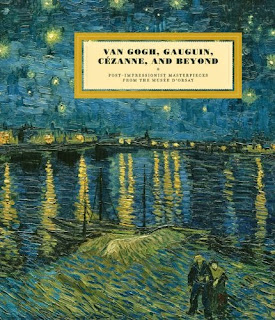
A while later I turned to the pile of envelopes and noticed a book. Had someone returned a book I had loaned? I didn't remember loaning anything out this term. But no, it was a book of post-impressionist paintings from the Musee d'Orsey in Paris. A gorgeous book!

Post-Impressionist masterpieces from the Musee d'Orsay


Where had it come from? Who had left it for me? On the inside title page was printed:

"My favourites from the best museum in Paris. Here's to being more than our biology determines, here's to being able to get in your car and drive down to Mexico at any given moment."

I was overjoyed. Someone in my History and Theory of Biology class this term had understood.....

Monday, 25 May 2015

sharing the moments that bring us back to teaching, part 1

My last final exam this term was for my 3rd year histology class. A great class to teach; my students often enjoy it. But they also find it very difficult to master the material - so many details, so many interconnections to synthesize. One student who worked particularly hard and was particularly anxious about being accepted into medical school kept in touch with me throughout the term discussing her term paper, discussing her learning strategies seeking help to master histology. She was wound up so tight! As could be predicted, she was the last to submit her final exam to me. After handing in her exam she pulled out her smartphone and looked up and said to me "I just received the email informing me whether or not I got into medical school." Her trepidation was readily apparent on her face. She opened the email and gasped for joy. Doing her little happy dance she came over and gave me a hug. On her way out I asked her to keep in touch and let me know how her first year in med school goes. She bounced out the door of the classroom, feet barely touching the floor.

Was my face a little damp?

I smiled and was content.